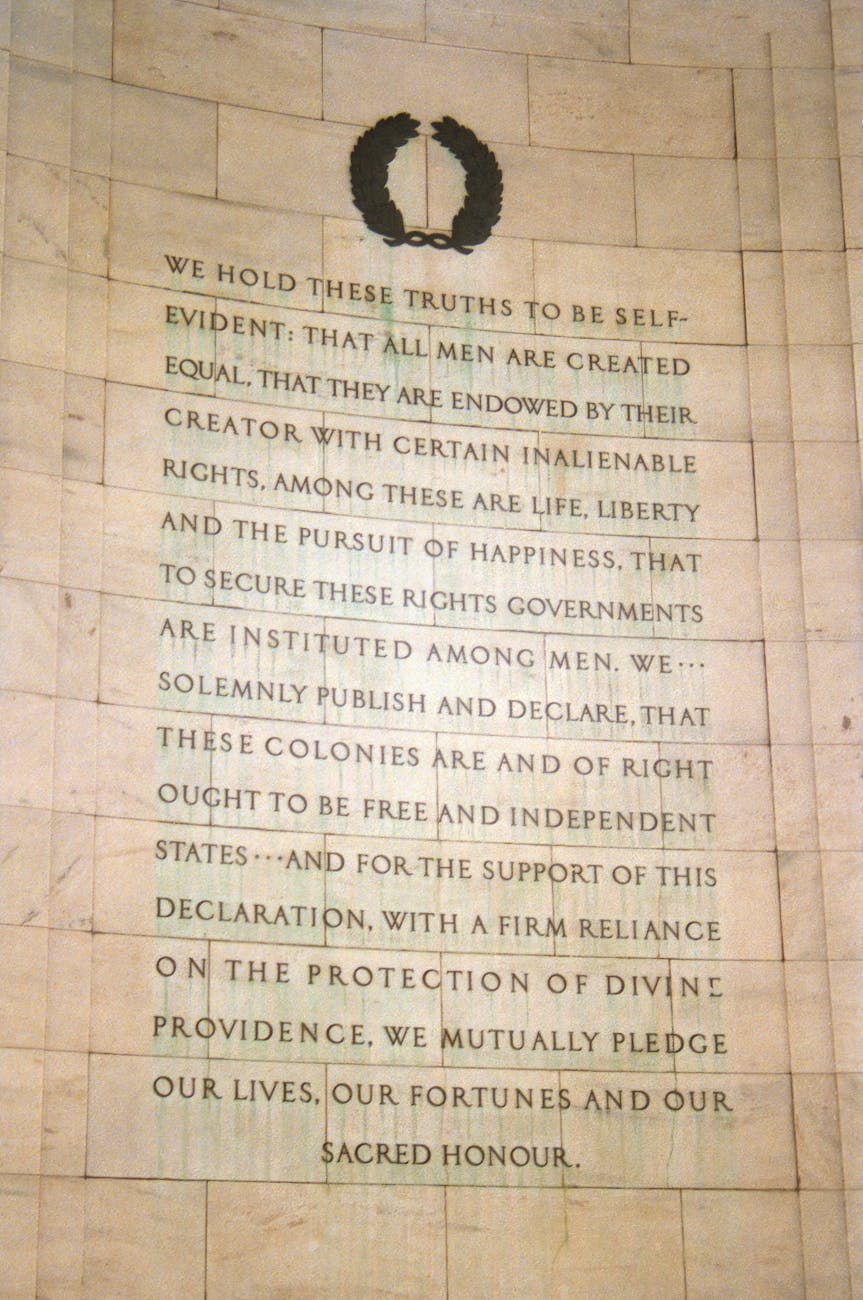
The Declaration of Independence is, probably without argument, the single founding document of the United States of America. Some would argue that it is the Declaration and the Constitution. However, America was created in 1776, recognized as a nation by our former “parent” country in 1783 and then the Constitution defined the federal government and its powers in 1787.
For this Independence Day, I wanted to take a look at a specific part of the Declaration and zoom in on it a bit for a closer look. It’s in the preamble, in the second paragraph. We all know it pretty well…well, maybe not all of us, but probably you guys all do.
“We hold these truths to be self-evident; that all men are created equal, that they are endowed by their Creator with certain unalienable rights…”
Something I appreciate about our Founding Fathers is their intelligence and skill at being able to pack so much thought into so few words. And now, here I am doing an entire podcast on those few words using far more words than are in the entire document. But then, I never claimed to be nearly as smart as men like Thomas Jefferson.
The first thing I want to point out was that the Declaration of Independence was formally titled “The unanimous Declaration of the thirteen united States of America.” That word “unanimous” is fairly significant. Jefferson writes that “all men are created equal” and every single delegate who signed his name on that document agreed to that sentiment. So, I think it bears a bit of consideration, if you’ll indulge me.
Let me start by asking a question. What does it mean to be “created equal?” By that I mean, when we say that we are “equal,” in what way are we equal? Based on what follows this claim in Jefferson’s writing, I would say that, at the very least, he meant that we all have the same “unalienable Rights” such as the right to life, the right to personal property, and the right to make our way in the world as we see fit; to set goals and pursue them in order to attain our own dream of what we would like our lives to be like (up until the point at which doing so would infringe on someone else’s rights, in which case, that’s where the part comes in about governments being created “to secure these rights”).
What this comes down to is, for example, if someone murders another person, they are to be prosecuted by the law regardless of who the person was whose life was taken or who it was who took that life. The system doesn’t care who a person is. The system simply recognizes that one has certain rights by virtue of being human and that we have various authorities in place whose job it is to enforce the protection of those rights for everyone.
Now, the next question is a bit more complicated. If we are to say that all people have these same rights and that the single factor for claiming these rights is that one is a human being (yes, other creatures have rights, too, but none of them signed the Declaration), the question is, what is it about humans that causes us to have these rights?
In order for us to claim these rights as humans, there must be some attribute or property that makes these rights real. If we start thinking about different properties, we can eliminate quite a few of them. I think we can count out things like height, eye color and shoe size right away.
What about physical strength? Or hand-eye coordination? Intelligence? Wealth? Athletic ability?
None of these would work either. Not only are they trivial, but they are also properties that one can have to different degrees. If we were to anchor our human rights to a degreed property, say athletic ability, one could then make a case that Lebron James is more entitled to his human rights than I am to mine because he is far superior to me in that category.
What, then, might it be? What do all humans have in common that is:
- Not arbitrary, but significant
- Not a degreed property, but held equally by all humans
There is only one thing that I can think of that would work. In fact, Thomas Jefferson alluded to it in the passage we looked at above. One thing we all share in equal amounts that is substantial enough to make us valuable and establish rights to all human creatures is that we are all made by the same Creator. The scriptures go a step further. We not only were all created by God, but are made in His own image (Genesis 1:27).
People far more intelligent than I am have pointed out the fact that, if you want to understand the ideas and philosophies that created the Declaration of Independence and the United States Constitution, and our federated republic that is designed to be, as Abraham Lincoln noted, “of the people, by the people, for the people…,” then you must have a firm grasp on Christianity. What it is. What it teaches. Its worldview. How it informs our lives, our ethics, and our politics. That doesn’t mean you have to be a Christian. Only that you understand what it means, or at least what it meant to the people who signed that original Declaration.
Sadly, our understanding of Christianity has changed dramatically in the past 200 years or so. Because of some of the ideas of people like G. W. F. Hegel, Karl Marx, Charles Darwin and others, our understanding of Christianity has been severely altered from what it had been for the first 1800-ish years. Even among many who attend church regularly, there are quite a few very misguided and uninformed ideas about what it means to be a Christian.
I don’t want to make this a sermon, but I do want to encourage you to take some time to understand the minds of the men (and women) who built this country. I will be putting a number of links in the show notes for some great resources that you can access in order to understand them better, and understand better why we had to break away from Great Britain. Why they set up our republic the way they did. Why they drafted and ratified the Bill of Rights.
In the meantime, I hope that you at the very least take a moment on Independence Day to remember how we got where we are. Remember the men who pledged “[their] Lives, [their] Fortunes and [their] sacred Honor” to implement the republic that still stands to this day.
Happy Independence Day, everyone.
 Heart, Soul, Mind and Strength
Leave a comment