
Help support this site:

I have a few questions I’d like to pose to get you thinking about a few things.
When you hear some breaking news or see some viral video of someone doing something to someone else, how quickly do you decide who’s guilty or innocent? Once you’ve made up your mind, do you stick to it, or are you open to new evidence? Do you share your views on social media, argue with other people about them, or scroll through heated debates and “like” posts that align with your position?
In my very first episode of this podcast, I talked about the fact that we almost never have 100% certainty about pretty much anything because there are so many factors and variables that need to be considered to determine the truth in just about every given situation, and humans simply do not have the capacity or access to all of them. Therefore, we are virtually never able to be 100% certain about any given thing that may have happened.
That doesn’t stop many people, unfortunately. For millions of people, just one short video of some incident from a single camera that didn’t even begin recording until after things escalated seems to be enough to come to a conclusion about what happened with such certainty and clarity that they might be willing to resort to pretty drastic action.
Hang on! Are you talking about something in particular? Nope. In fact, I’m not. Sadly, I wish this only described one particular incident, but it doesn’t. There is an increasing number of these types of things happening all the time nowadays.
In Episode 10, I talked about how everything is connected and it’s all downstream from our theology and affects things like how we judge others. Here is an example of how our understanding of the world we live in informs our moral principles.
As humans, made in the image of a Just God, we all seem to have some sort of built-in sense of justice. We want good people to be rewarded and bad people to be punished. This is something almost all of us can agree on, regardless of whether or not we believe God actually exists.
It is this sense of justice that moves us when we see one of these videos posted on social media. “How could anyone do this?” “How can we let that happen?” “That person is going to have to pay for what they’ve done!”
The Court of Public Opinion tends to deliver a verdict within a few minutes of seeing a short snippet of video. Guilty as charged. Sometimes, guilty before charged. Now that that’s over with, we will watch to see if we need to take steps to make sure that the actual legally selected jury comes to the correct conclusion of the matter. If it looks like they might start waffling on us, we’ll have to find a way to apply some pressure to make sure they don’t make that mistake.
We already know what justice requires. Our minds are made up. Don’t confuse us with facts. Now it’s up to a jury of people who will be shown far more evidence and information than anything we got from our little video clip to come to the same conclusion we already did before the video was even half over.
We know so very little about so very many things. Yet we are so absolutely convinced that we have all the information necessary to make critical decisions, even those that could affect a lot of people. Often in error, but never in doubt.
No matter how many times you are told the lesson about how much of the iceberg is below the water, no matter how many times your parents have told you not to judge a book by its cover, we still can’t help ourselves. We don’t want to have our judgement muddied with a bunch of facts, perspectives or a broader context. We want things simple, clear, shallow. It’s just easier that way.
It wasn’t always this way. There was a time when it was considered “common sense” that there could be good men, even great men, who had very serious flaws. Yet those flaws did not prevent us from thinking of these men as great.
We don’t need to look far. Just look at our Founding Fathers. George Washington, Thomas Jefferson, John Hancock, Benjamin Franklin, and my favorite, John Adams. These were all great men. Flawed men. But great men.
Today, when we idolize some particular person, it seems as if we are so shattered and disappointed when we find out some grievous sin they’ve committed, that we can’t possibly ever think or say anything positive about them ever again. This is the very thing that people mean when they talk about “Cancel Culture.” It’s an all-or-nothing sort of thing. We throw away memorabilia, burn t-shirts, take all their music off our playlists, and nobody is allowed to even say their name around us.
This is a very useful way to go through the world if we want to have less healthy relationships, more divisiveness, more violence, more stress, less joy and more pain and suffering.
So, what’s the alternative? Well, for one thing, we could wait before coming to a conclusion about things. When a new viral video hits social media, maybe we wait for an investigation to get more information to come out before we decide the verdict, and ultimately the fate of the accused. Maybe we need to remember that humans are composed of both good and bad. On the one hand, we are good…made in God’s image and we have His law “written on [our] hearts” (Romans 2:15)…but also bad…”there is no one good, not even one” (Romans 3:10).
We can try to remind ourselves, even when we legitimately see someone behaving badly (a man shouting at his wife, a parent seemingly paying no attention to their child, a customer getting angry at a cashier) that we don’t know all the variables that brought them to this exact moment. We don’t know what they’re going through, what weight is on their shoulders, what stress they have in their life.
Without knowing those things, we have no legitimate cause to jump to conclusions about their character or what kind of person they are. Anyone who has ever lost a loved one, lost a job, gotten buried in financial debt, found out about a cheating spouse or anything traumatic…you know that, in those moments, you were probably not at your best. You may have been short with people or rude. You may have seemed distant or distracted. Maybe, when you see someone else behaving that way, they’re going through something.
So, now I pose a challenge to you. The next time you want to react to some breaking news about a reported injustice, take a pause. Wait for the rest of the facts to come in. A good rule of thumb is to wait at least 72 hours. Typically, during that time, a whole lot of new information comes to light really quickly. Most importantly, whenever you do begin to form your own conclusions, remember, there’s always a chance that you’re wrong.
If you want to discuss it with people you disagree with, great! Do that. But be respectful and realize that there are generally three possibilities as you get into your discussion:
- You are right and they are wrong
- They are right and you are wrong
- You’re both wrong and the truth is something else, entirely.
One of my very favorite people to teach on this sort of thing is Greg Koukl. Greg is the host of the Stand to Reason and the #STRAsk podcasts where he takes questions and challenges from listeners and engages with them in discussion. But he has a very particular rule when he is discussing things, especially with people who don’t agree with his worldview. “If I get mad, I lose. If they get mad, I lose.”
The Apostle Paul wrote, “If it is possible, as far as it depends on you, live at peace with everyone.” (Romans 12:16) And Peter tells us to be ready to answer people who don’t share our view “with gentleness and respect” (1 Peter 3;15).
So, let’s maintain some humility, because we can always be wrong. And let’s treat each other with respect and have a civil discussion about our disagreements.
Stay humble and stay grateful.
The Coddling of the American Mind – Jonathan Haidt

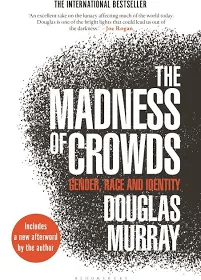
The Madness of Crowds – Douglas Murray
 Heart, Soul, Mind and Strength
Leave a comment