Help support this site:

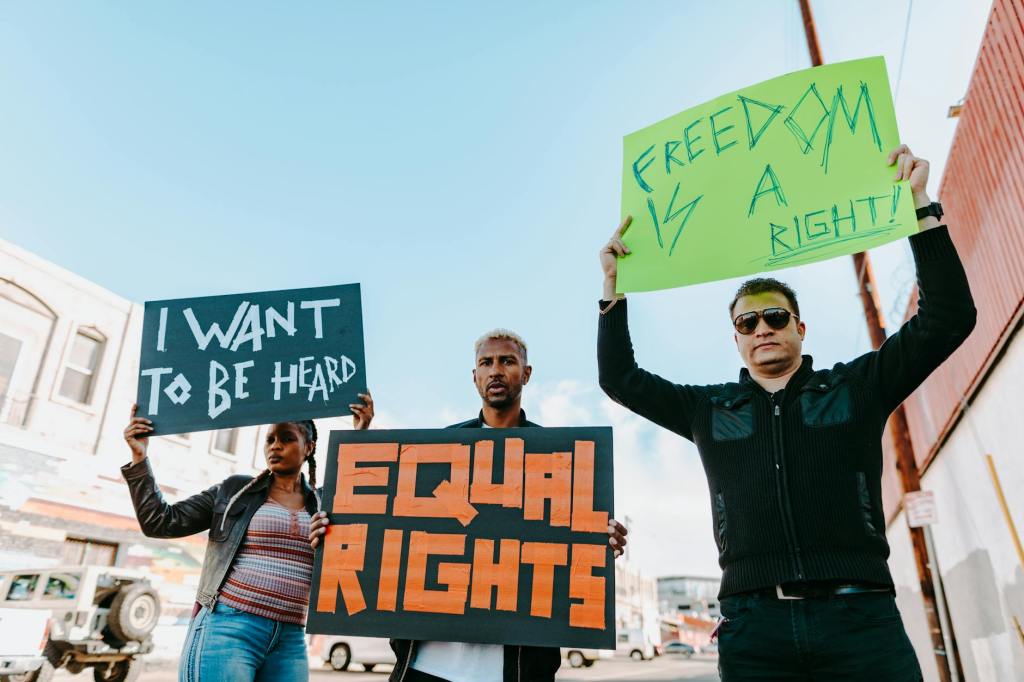
Over the last couple of decades, it seems like I’ve heard a good deal of ballyhoo about rights. Various groups of people are protesting this or that government agency or elected official about rights being violated or taken away or not recognized or what have you. But when some of these people talk about rights, what is it that they’re talking about and what do they mean?
First, as I typically like to do, let’s define “rights.” A right is a fundamental principle that applies to all people by virtue of them being human. They are universal, though not necessarily universally recognized. But, because they are fundamental, they are not dependent of factors like race, political affiliation, economics, age or education.
Typically, rights protect freedoms. They can be broken down into two major categories; positive and negative. Let’s take a look at what negative rights are and then we’ll get into positive rights.
A negative right essentially negates certain actions from being allowed. For example, my right to personal property is such that it disallows another person from taking my stuff. This, and other negative rights, were largely addressed by the Founding Fathers when they wrote the Declaration of Independence, the Constitution and the Bill of Rights.
Positive rights require certain actions. A right to health-care, for instance, would be a positive right because it requires one or more medical professionals to do something when I need medical care. This is the primary difference between positive and negative rights.
Let’s take a closer look at some negative rights and where they came from.
The founding document of the United States of America is the Declaration of Independence. In this document, Thomas Jefferson mentions that we are “endowed by our Creator with certain unalienable rights,” a nod to a divine authority from the Magna Carta of 1215 when the king was forced to recognize that he, himself, was under the authority of a divine ruler.
Because they come from an authority higher than the government, the government can neither eliminate nor violate these rights without proper justification. While there may be times that a particular right has to be waived, those situations tend to require a lot of scrutiny to justify due to the fact that these rights are so fundamental to being human.
So what are these negative rights? Well, Jefferson notes a couple of them explicitly in the Declaration; life, liberty, the pursuit of happiness. Other negative rights were recognized in the Bill of Rights; free speech, freedom of religion, the bearing of arms, security of personal property, etc.
On the other hand, when it comes to positive rights, there is much less information in the founding documents. Some of these could include things like the right to a speedy and public trial as mentioned in the Sixth Amendment. While more controversial, some might consider the “general welfare” clause in the preamble of the Constitution to be a positive right, though that is not quite as clear.
Some of the more contentious issues in modern culture seem to be around the topics of various claims to rights such as health care, housing, abortion, education, etc. It should be noted that all of these would be more closely aligned with positive rights as they all require someone to take action.
When I think about it, I can’t help but pose the question as to whether or not these sorts of things are rights in the first place. I don’t doubt these things are good to have, but does the fact that they are beneficial automatically mean that they should be fundamental rights? I don’t see how that follows.
For most of human history, people did not have rights to things like health care or education. It seems to me that, if these were fundamental human rights, they would have been a priority earlier than just that last couple of centuries. However, education was long considered a privilege exercised only by the wealthy (or extremely lucky). Health care is a particularly modern innovation. There could be some debate about whether or not the progress of civilization, such as advances in medicine, could engender new rights that didn’t exist before.
So, I guess an important question to ask is, how do we determine that something ought to be considered a fundamental right? And, how does this compare to something like privileges and entitlements?
Again, we go back to some basic definitions. We’ve already defined rights, so let’s look at privileges. A privilege is usually granted by some governing authority. That can be national, state, local or even among a single family. These are not universal, like rights, but require certain conditions or qualifications. Also, unlike rights, they can be revoked at the discretion of the one who granted them. A driver’s license is an excellent example of a privilege. If you violate traffic laws, your license can be revoked.
What about entitlements? Like privileges, they are not universal and they require certain criteria to be met in order to qualify for them. They are typically established by some level of government by program or policy and tend to be tied to legal statutes or regulations. They can also be changed at any time based on political will or economic conditions or a host of other things. Social Security is a great example of an entitlement. There are eligibility requirements and your payments can vary depending on your financial circumstances.
So, looking back at something like health care, would that qualify as a right, a privilege or an entitlement? I think we can rule out privilege and narrow it down to being either a right or an entitlement. But which is it? I would contend that it is more appropriately categorized as an entitlement as it seems to fit into that definition much better. Others might argue that it ties in with the right to life. That seems like an important discussion to have.
As I mentioned, education has historically been considered a privilege as it was usually only available to the wealthy. Nothing about the concept of education has changed to suggest that it is now a fundamental right, though perhaps today, it might qualify more as an entitlement than a privilege.
My point here is not to adjudicate whether or not these things qualify as rights versus privileges or entitlements. It is merely to point out that there are differences between the three and that those differences matter. If we are going to claim a right, we need to accurately establish why it should be considered a right rather than one of the other two options.
The reason this is important is because we tend to have a visceral, sometimes even violent, reaction when our rights are being violated. This is perfectly understandable when one understands what rights ultimately are. The violation of rights is tantamount to a violation of our very humanity.
If we see things as privileges or entitlements, however, we might be disappointed if we lose them, but we are less likely to get quite as angry and violent in those cases. Therefore, it should be only after careful consideration that we categorize something as a fundamental right in order to avoid going to war over something that may not warrant that level of retribution.
Understanding the differences between these categories is more than merely an academic exercise. By recognizing these distinctions, we shape and inform how we respond to any changes or challenges to our freedoms, values or benefits..
Until next time…
The Federalist Papers – Alexander Hamilton, James Madison
The Anti-Federalist Papers – Patrick Henry & Others

The Second Treatise of Government – John Locke
 Heart, Soul, Mind and Strength
Leave a comment