Recently, I was engaged in an excellent discussion with someone about what has become something of a political issue over the past few decades. It wasn’t anything super controversial or anything, just abortion.
If you have heard some of my previous episodes, it might not be a huge surprise to you that I would consider myself solidly in the pro-life camp on this issue. However, I do love having good, respectful discussions with people who disagree with me.
Don’t worry, though, I’m not making a case for or against abortion today. So, while I will reference this conversation, it is only to use it as an example of how our governmental system is designed to work.
We started out discussing whether or not the Founding Fathers would have considered abortion to be a Right covered in the Constitution. After all, there has been much contention over recent years that Roe v Wade should not have been overturned and that doing so somehow removed a Constitutional right to an abortion.
It didn’t take much time to get to a point of agreement about the fact that abortion is not, in fact, a Constitutional right and was certainly never thought of that way by the people who wrote it. We agreed that John Adams, George Washington, James Madison, and even Thomas Jefferson would have been astonished that something like this could ever even be considered by civilized people.
The conversation moved forward and I had argued that legislating this issue at the level of the Federal government, regardless of which side one is on, would be a terrible idea. My argument was based on the idea that the population of one state might have largely different feelings about this than the population of another state. Therefore, whichever way the Federal government decided to implement a law regarding abortion, a very large portion of the People would be exceedingly unhappy about it.
It was my position, at the time, that only policies that have extraordinarily high degrees of approval across various demographics and a majority of states should ever be legislated at the Federal level. To do otherwise would alienate half the population by forcing them to comply with ideals that were shoe-horned into law by the other half of the population.
Upon further reflection, it seemed like there might be some problems with this theory. The writings of the Founding Fathers seemed to further support that there was a flaw in my thinking. Even when looking at the first attempt at a General government, in the form of the Articles of Confederation, not to mention the explicitly enumerated powers given to the Federal government in the Constitution, I couldn’t get away from the fact that I needed to rethink things.
For example, the overwhelming majority of people of every single state in this nation would probably agree that there should be laws against murder, the unjustified killing of another human being. However, based on the logic I had been using, with that sort of ubiquitous support, shouldn’t laws against murder be handled in Washington D.C.? Yet, they are handled by each state, individually. Yes, I know that there are some federal laws regarding murder, but those only apply under specific circumstances.
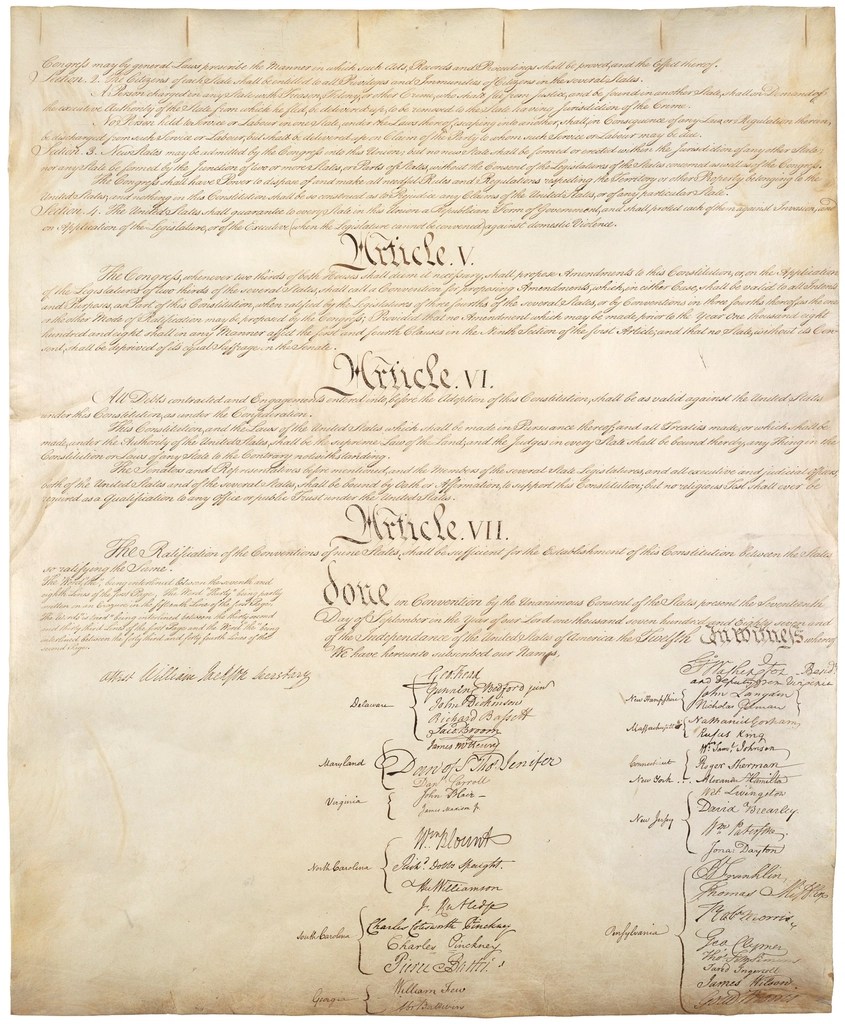
When considering the Constitution itself, along with various letters written to and from the men who were largely responsible for how the Constitution turned out, it started to become clear to me that the purpose for the Federal government (what they referred to as the General government) was to handle things that the individual states did not have sufficient capacity to legislate and enforce on their own.
For example, it would not be feasible for each individual state to send delegates to negotiate with foreign nations regarding things like treaties or trade agreements. So, the Federal government represents the states in that situation. Interstate commerce and a unified currency were also things that would be best left to a centralized government, otherwise, there would likely have been wars between states over these kinds of things.
The states, however, are perfectly capable of legislating and enforcing laws prohibiting murder, theft, assault, and so on. Therefore, these crimes are handled by the states individually. There is no need for a centralized government to step in and handle them, so the states maintain their sovereignty regarding these laws and criminal justice in general.
Coming back to the original conversation about abortion, as I already said, any decision or law passed in Washington D.C. would make a significant portion of the population unhappy and they would feel that their values and ideals were being violated. Whereas, by legislating this on a state-by-state basis, people can congregate and live among the states whose populations largely agree with them on this issue and avoid living in states where the population largely disagrees with them.
Who wants to live their lives surrounded by people they disagree with anyway? That seems so exhausting! I’m not saying it’s an easy thing to move to another state if you’re in that situation now, but at least it’s an option, where a Federal law would eliminate that option.
Now, as I come to a close with this, I do want to point out something that I think is very important. A couple of things, really.
First, this idea of legislating at the correct governmental level is relevant for more than just abortion laws. That was just the issue I chose in order to illustrate my point. This should be taken into consideration with every law that is submitted or considered. The question should be asked, “Is this the most appropriate level of government for this to be legislated?”
Second, keep in mind that there are more levels of government than just Federal and state. Some things might be better legislated at the county or municipal level, given that many states, while largely leaning one way or the other politically, have pockets of communities that lean the opposite way. Those people’s ideals should not simply be pounced just because there are fewer of them in the state overall. The general rule of thumb should be, the more directly something impacts people’s everyday lives, the closer to home it should be legislated.
And lastly, not everything that we think is wrong should be legislated and made to be illegal. Sometimes, we need to rely on simply persuading people to our point of view so that they won’t choose to do the things we wish they wouldn’t or vice versa. For a long time throughout human history, people simply didn’t do things they felt were immoral regardless of whether or not it was legal. We still can do that, today. Just thought you might like to know.
In fact, I think it would be best, at every level of government, to generally avoid legislating issues before successfully persuading a significant majority to be in agreement on it. If not, it becomes one side beating the other side over the head using lawfare. Convince people that you’re side is right and they’ll be happy to legislate the things most people agree on.
So, let’s be thoughtful about how we legislate, at what level, and who is impacted by it. And let’s also keep an open mind that we can, and should, have discussions with each other and work to respectfully persuade people to our point of view on things rather than coming down with the hammer of the law every time someone does something that we think they shouldn’t do.
With that, have a calm, rational, fruitful and polite discussion with someone you disagree with…until we come back for the next episode.
The Founders’ Key – Dr. Larry Ann

The Case for LIFE – Scott Klusendorf

 Heart, Soul, Mind and Strength
Leave a comment