
Is Christianity a “blind faith?” Typically, when someone mentions “blind faith,” what they mean is something like the idea of believing something without any evidence, or at least without sufficient evidence.
Is that what Christianity is all about? Does it seem plausible that Christianity would have lasted for roughly two millennia and would include some of the most brilliant scientific and philosophical minds throughout human history if it required belief despite a lack of sufficient evidence?
Let’s take a look at the idea of “faith” first. For some reason, this word, when applied to theological belief, seems to mean something akin to a wish or a hope. Not the sort of hope that is often referred to in the New Testament, which is more of an expected outcome, but rather it seems more like hoping that your lottery numbers are picked so that you can win.
To a degree, the common understanding of “faith” is almost synonymous with the “blind faith” that we’re looking at today. It’s almost as if the “blind” part is just implied when talking about faith.
What is strange to me is that it seems that theological or religious beliefs are the only ones that seem to view the concept of “faith” in this way. In every other context that I can think of, “faith” is more synonymous with “trust.” We see this when we talk about a spouse being “faithful.” We see it when someone makes a show of “good faith.” We see it when United States Marines claim to be “always faithful.”
In all of these contexts, when we are talking about being faithful, we are referring to the idea that the person who is “faithful” is one who can be trusted and relied upon. Whether we’re referring to a spouse, a soldier, a bank or a potential business associate, the idea of having “faith” in them is an indication that one feels a sense that this individual can be trusted.
The “blind” part of “blind faith” is, as I mentioned, implied in this common idea of “faith” as so many people tend to think of it. It generally implies an unknown or a lack of supporting evidence. So a “blind faith” is a sort of non-rational (or to some, irrational) belief in something that is blind in the sense that there is no valid reason for holding that belief.
If, on the other hand, we take “faith” to be synonymous with “trust” and we apply the “blind” concept to it, I would say that there is a sense in which that is accurate. If you go back to Civil Discourse (my very first post), I mention that we hold most of our beliefs with something less than 100% certainty. In other words, we have a bit of a blind spot.
Yet, when we put our “faith” (as in “trust”) in something, we are doing so with 100% commitment. I don’t sit around wondering if my wife is doing something behind my back because I trust her. Am I 100% certain that she wouldn’t do something that, if known, would damage our relationship? I don’t think anyone could say that. But based on my experiences with her since we’ve been together, I have enough evidence to make me reasonably certain, which in turn allows me to not have to hire someone to follow her around and verify that nothing is going on.
In other words, there is a “blind leap” from whatever degree of certainty I have in her trustworthiness, which is based on my experiences and evidence, and the 100% trust I extend to her by not having her followed around to “catch” her doing something wrong.
Now, I don’t think I could ever put an exact figure on it, but just for the sake of illustrating the point, let’s say that I am 99% certain that she would never betray me. Therefore, I 100% do not check up on her. That 1% difference is where the “blind faith” area would be. I don’t know for sure (“blind”) but I will trust her (“faith”) based on the evidence and experience I have with her (the other 99%).
I make the leap from the less than 100% certainty that I have to the 100% trust with regard to my behavior toward her.
A similar, popular analogy is air travel. Of course, one can never be 100% certain that an airplane will get you safely to your destination. However, you definitely commit 100% by getting on the plane and staying there through take-off.
While you can’t possibly be 100% certain that you’ll be safe, based on historical data and what we commonly know about the safety measures taken by airlines including all the pre-flight checks and other various things that they do before each flight, there has been a pattern of successful flights that give them enough credulity that we can (more or less) comfortably trust that we will arrive safely at the other end of the flight.
Regardless of the percentage of uncertainty, you cannot partially commit to being on the airplane. You’re either on or off. If you distrust it more than you trust it, chances are you’ll find some other way to get where you’re going. But, if you trust it even slightly more than you distrust it, you will likely get on board. You might feel uneasy about it, but you’re 100% committed. That is the leap of faith you take in the airplane and the crew.
So, there is a sense in which Christianity involves a blind leap of faith. With what we can assess based on historical records, archaeological evidence, cultural traditions, philosophical reasoning, scientific understanding of the natural world, etc., we have enough evidence to reasonably conclude that the claims at the core of Christianity are true.
We can be reasonably certain, based on all the evidence, that while our sin separates us from God, Jesus, the messiah, the Christ, the “anointed one,” was able, by His death, burial and resurrection, solve the sin problem for us so that we could be reunited with God for eternity.
Can we be 100% certain? Nope. But we can be reasonably certain to the degree that we put 100% of our trust in Him that He will effectively pay our sin debt so that we don’t have to pay it ourselves.
In return, we give Him our love, affection and obedience (to the degree that we are able) not in order to receive this gift of forgiveness, but in response to the already received gift. And the great thing is, this offer is open to everybody!
No matter your age, nationality, skin color, skill level, background or colorful past, Jesus made a way for every single one of us to be forgiven. And if you are even just barely over 50% certain that it’s true based on an objective review of the evidence, it is reasonable to dedicate your life to accepting and responding to His grace and sharing it with as many people as you can.
It’s not guaranteed to make your life easier, but it will make it better. Take that leap of faith yourself. You won’t regret it.
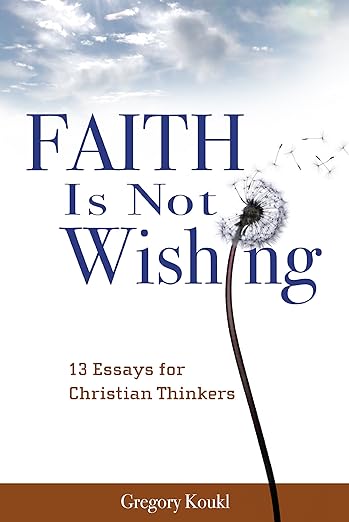
Faith is not Wishing – Greg Koukl
 Heart, Soul, Mind and Strength
Leave a comment