
Have you ever heard of the concept of “undesigned coincidences” in the Bible? It’s basically the idea that you can read a part of the Bible and the author mentions some detail that ends up resolving some sort of question that may have come up in another passage, perhaps by a completely different author.
One of the most common examples of this occurs between the gospels of Matthew and Luke. First, we’ll take a look at the passage in Matthew. This takes place, of course, after Jesus had been arrested.
67 Then they spit in his face and struck him. And some slapped him, 68 saying, “Prophesy to us, you Christ! Who is it that struck you?”
– Matthew 26:67-68
One might read this passage and wonder why it is that they would ask Jesus who struck Him? I mean, if I was walking through a crowd of people and one of them came up and hit me, I’d probably have a pretty good idea who did it. Likely, I saw them coming.
This is answered via an “undesigned coincidence” in a parallel passage from Luke:
63 Now the men who were holding Jesus in custody were mocking him as they beat him. 64 They also blindfolded him and kept asking him, “Prophesy! Who is it that struck you?”
Luke 22:63-64
So, that’s why they were challenging Him to identify who hit him. He was blindfolded! Now it makes sense. Luke provides a detail that clears up the confusion from the passage in Matthew. There are a number of these undesigned coincidences in scripture.
I’m not sure that the passages I want to point out today qualify as undefined coincidences, but I think they might. And, since I have never really heard about them being pointed out before, I thought it would be interesting to do that now.
The story I want to focus on deals with Jacob and his wives, Leah and Rachel.
You probably are familiar with the story from Genesis 29. Jacob has been sent to his uncle Laban in order to escape his brother Esau’s anger at the fact that Jacob has stolen Esau’s blessing as the firstborn. When Jacob gets to Laban’s home, he sees Laban’s daughter Rachel and falls in love with her.
He agrees with Laban to serve him for seven years for the hand of Laban’s younger daughter, Rachel. After seven years of working for Laban, Jacob wants his wife. He is very excited to get on with this, particularly the wedding night.
Unfortunately, Laban ends up tricking Jacob and gives him the older sister, Leah, instead. I guess it was dark in the tent and Jacob had had more than a few drinks and…well…you know. It happens, I guess.
Anyway, you can read that whole section of Genesis yourself for all the details. The short version is, Jacob marries Leah and then eventually marries Rachel. Further chaos ensues, but that’s not really what we’re going to focus on today.
As I was reading through Genesis, I happened to notice something that I had just breezed past many other times without really thinking about the significance of it. The first thing I saw was this:
9 So Rachel died, and she was buried on the way to Ephrath (that is, Bethlehem), 20 and Jacob set up a pillar over her tomb. It is the pillar of Rachel’s tomb, which is there to this day.
– Genesis 35:9-10
Here we see that Rachel dies, as it turns out it was during childbirth, and is buried “on the way to Ephrath…” At first, as I said, I hadn’t thought much of it. But then, something jumped out at me a bit later.
31 There they buried Abraham and Sarah his wife. There they buried Isaac and Rebekah his wife, and there I buried Leah
Genesis 49:31
Jacob is making arrangements for his burial. In doing so, he mentions that he is to be buried in the family tomb along with Abraham and Sarah, with Isaac and Rebekah, and also…with Leah. So, Leah was buried in the family tomb. Rachel, Jacob’s love, the wife he ultimately worked as a slave for 14 years to marry, was buried “on the way to Ephrath.”
This woman whom Jacob so loved was buried some place by the side of the road and the wife that he didn’t want gets to be in the family tomb? What is going on there?
Well, if we were to spend the time here going over the concept of marriage in the Bible, it would hopefully be pretty clear to people that God’s idea of marriage involves only one wife per husband, not two.
Since Leah married Jacob first, it seems that, in the eyes of God, Leah was the only legitimate wife that Jacob had. Therefore, she was the wife buried in the family tomb as a way of recognizing her role in that family.
I don’t know about you, but I thought that was pretty neat.
But that’s not the only interesting thing I had noticed with regard to Leah. Remember, she was not the one Jacob favored. Jacob was head-over-heels in love with Rachel, not Leah. And Leah was not taking it so well. Let’s take a look at how she felt about bearing Jacob his sons:
32 And Leah conceived and bore a son, and she called his name Reuben, for she said, “Because the Lord has looked upon my affliction; for now my husband will love me.”
33 She conceived again and bore a son, and said, “Because the Lord has heard that I am hated, he has given me this son also.” And she called his name Simeon.
34 Again she conceived and bore a son, and said, “Now this time my husband will be attached to me, because I have borne him three sons.” Therefore his name was called Levi.
Genesis 29:32-34
Her first three children were, as far as she was concerned, a means to an end. Each one of them was just a tool that she would try to use to win Jacob’s favor. How would you like to have grown up in that environment?
It’s too bad they didn’t have family counseling back then. We end up seeing how they turn out…selling one of their own brothers into slavery and then lying to their father that he was killed by a wild animal. No dysfunction in that family.
But that’s not the end of the story, of course. What happens when she has her fourth boy?
5 And she conceived again and bore a son, and said, “This time I will praise the Lord.” Therefore she called his name Judah. Then she ceased bearing.
Genesis 29:5
Don’t miss this one. It’s slightly more subtle than the thing with the tombs. How does she act with the first three sons? She uses them to get Jacob’s affection. Her fourth son? She praises God. What was the name of the son for whom she praised God? Judah. Whose line did Jesus come from? That’s right…Judah.
How did I not see this all those other times I had read this? Am I the only one who thinks this is extremely cool? Maybe I’m just that much of a nerd, but I think it’s amazing.
Speaking of Judah, do you remember when Jacob was going to send his sons back to Egypt for more food and they pointed out that they were not allowed to go back without Benjamin? Jacob didn’t want to send Benjamin because he was afraid he would never see him again.
8 And Judah said to Israel his father, “Send the boy with me, and we will arise and go, that we may live and not die, both we and you and also our little ones. 9 I will be a pledge of his safety. From my hand you shall require him.
Genesis 43:9
Judah volunteers to basically be the ransom price for Benjamin. Does that sound like any particular individual who may have come into the world through the line of Judah some time later?
These are just a few of the things that I couldn’t help thinking were so incredibly cool in the Bible. It’s easy to pass these things by and think nothing of them. It makes me wonder just how many other things like this I still keep missing.
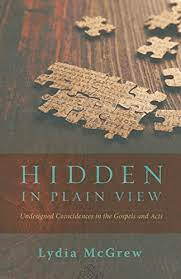
For more details on undesigned coincidences in the Bible, checkout out this great resource from Lydia McGrew and Det. J. Warner Wallace
 Heart, Soul, Mind and Strength
Leave a comment